
Medical practices depend on accurate billing for financial stability. Services that involve drugs, infusions, and certain medications require special coding. Among those, J‑Code in medical billing plays a key role.
These codes help providers bill for injectable and infused pharmaceuticals. They signal to payers exactly what was administered, how much, and why it matters to the patient’s treatment.
This article explains what J‑Codes in medical billing are, where they come from, how they work in claims, and why accurate use improves reimbursement. We also explore best practices for accurate J-Code billing to help healthcare organizations and medical billing services providers.
What Are J‑Codes?
J‑Codes are part of the Healthcare Common Procedure Coding System (HCPCS) Level II. HCPCS was established to support billing for services and products that are not included in standard CPT codes.
Medication administration, infusion services, and certain therapeutic supplies fall under HCPCS. J‑Codes specifically identify drugs and biologics that are often costly or require payer review.
The Centers for Medicare & Medicaid Services (CMS) oversees HCPCS, including J‑Codes. According to them, these codes help standardize claims for services that otherwise might vary widely in description and payment treatment.
Healthcare providers, coders, and billing staff use J‑Codes to communicate drug administration details clearly on claims. Without accurate J‑Code use, payers may delay payment or deny reimbursement.
What Does a J-Code Include?
A J-Code typically contains:
- A unique alphanumeric identifier beginning with “J.”
- A drug description
- The dosage basis per billing unit
- Administration context (injectable or infused)
- Coverage relevance under payer policies
Each element ensures that payers know exactly what was provided and in what quantity.
Why J-Codes Matter for Treatment Claims
Drug-related claims often carry higher reimbursement values. Because of this, payers review them closely. Accurate J-Code reporting protects revenue, supports compliance, and helps avoid preventable denials.
Financial Accuracy
Injectable medications can be expensive. If the wrong J-Code or incorrect unit count is submitted, reimbursement may not reflect the actual drug cost. Even minor calculation errors can impact revenue over time. Proper coding ensures payment aligns with the dosage administered and protects the practice from underbilling.
Compliance and Audit Protection
High-cost drug claims are more likely to face payer review. Clear documentation that supports the selected J-Code reduces audit risk. When coding matches the clinical record, providers are better positioned to defend claims and avoid repayment demands.
Medical Necessity Support
J-Codes must align with diagnosis codes that justify the treatment. Payers evaluate whether the medication is appropriate for the patient’s condition. Accurate linkage between diagnosis and drug code strengthens claim approval chances and reduces denials.
Faster Claim Processing
Clean claims that include correct J-Codes and unit reporting move through adjudication more smoothly. Fewer documentation gaps mean fewer delays. Efficient processing improves cash flow consistency for practices that frequently administer injectable therapies.
Accurate Data Reporting and Analytics
J-Codes also contribute to financial reporting. Practices analyze drug utilization patterns, reimbursement trends, and cost performance through coded claims data.
When coding is accurate, leadership can evaluate which therapies generate sustainable reimbursement and which require closer cost control. Reliable data supports informed financial decisions and long-term planning.
How J-Codes Work in Medical Claims?
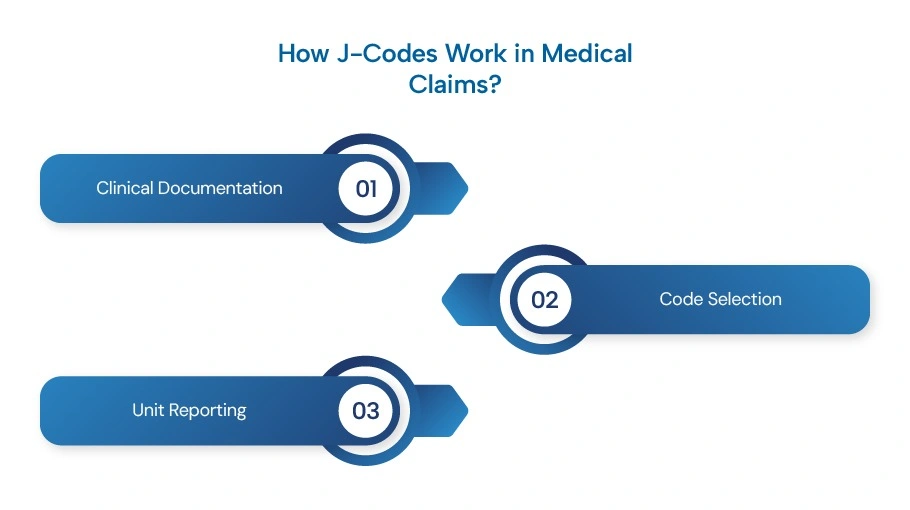
J-Codes appear on claim forms after services are rendered. They must match the clinical record precisely.
Step 1: Clinical Documentation
The provider documents the medication name, strength, dosage administered, and route. Clear documentation forms the foundation for correct coding.
Step 2: Code Selection
Billing staff review the record and select the correct HCPCS Level II J-Code. They verify dosage increments and payer coverage rules.
Step 3: Unit Reporting
Each J-Code corresponds to a specific billing unit. Claims must reflect the total number of units administered. Errors in unit calculation are a common reason for denial.
J-Code Unit Reporting and Dosage Calculation
J-Codes are closely tied to billing units. Each code defines a standard quantity, such as “per 1 mg” or “per 10 mg.”
If a patient receives 50 mg of a drug billed per 10 mg unit, the claim must reflect five units. Miscalculating units leads to underbilling or overbilling. Accurate conversion between administered dosage and billing unit is critical for reimbursement accuracy.
Practices should train billing staff to double-check dosage calculations before submission.
Best Practices for Accurate J-Code Billing
Accurate J-Code billing requires clear documentation, correct unit calculation, and consistent review processes. Small errors can lead to denials or underpayment. Billing teams should adhere to these best practices to improve claim accuracy and protect revenue.
Perform periodic internal reviews to identify coding errors, improve compliance, and strengthen denial prevention.
Confirm the correct HCPCS Level II J-Code, drug name, strength, and National Drug Code (NDC) before claim submission.
Record dosage, route, frequency, and medical necessity to support reimbursement and reduce payer questions.
Ensure billing units align with the drug’s dosage and HCPCS unit definition to prevent overbilling or underbilling.
Link the appropriate ICD-10-CM diagnosis to justify treatment and avoid medical necessity denials.
Typical J-Code Applications in Healthcare
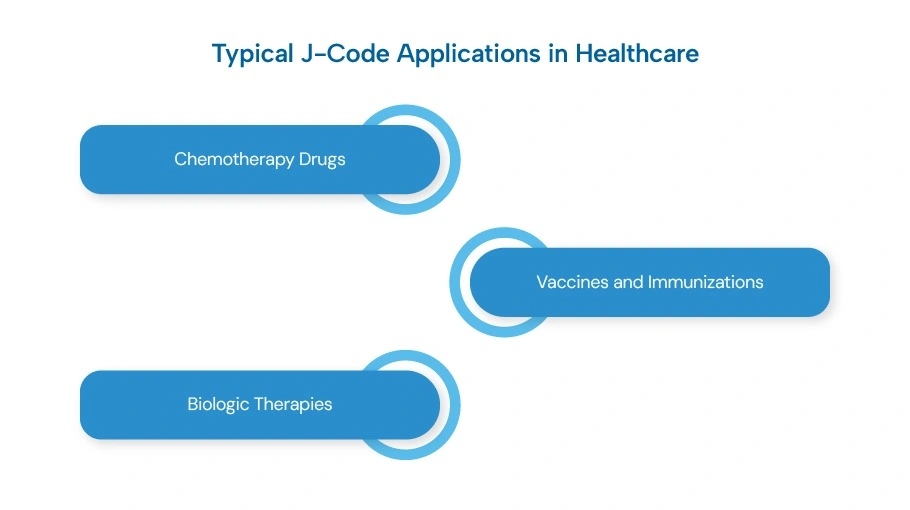
Certain drug categories consistently require J-Code reporting.
Chemotherapy Drugs
Many cancer treatment medications fall under the J-Code classification. These drugs are typically infused and require careful dosage documentation.
Vaccines and Immunizations
Some vaccines administered in clinical settings are billed using J-Codes, depending on payer guidelines.
Biologic Therapies
Biologics used for autoimmune conditions, arthritis, and inflammatory diseases are often reported using J-Codes due to their injectable nature.
Final Word
A J‑Code in medical billing is more than a label. It represents a precise way to report injectable and infused medications to payers. Accurate use of these codes supports correct reimbursement, reduces denials, and makes billing workflows more efficient.
Clear documentation and regular code updates are practical steps that improve financial outcomes for providers. With the right processes, practices can minimize claim rejections and enhance revenue performance.
Frequently Asked Questions (FAQs)
1- What is a J-Code used for?
It is used to report injectable and infused drugs administered in clinical settings for reimbursement purposes.
2- Are J-Codes only for Medicare claims?
No. While CMS maintains HCPCS, many private insurers also require J-Code reporting.
3- How are J-Code units calculated?
Units are calculated based on the dosage definition listed within the code description. The total administered amount is divided by the billing unit amount.
4- Why do J-Code claims get denied?
Common reasons include incorrect units, outdated codes, insufficient documentation, or a lack of medical necessity support.
5- How often are J-Codes updated?
HCPCS codes, including J-Codes, are typically updated annually. Practices must review changes each year.