
Key Takeaways:
- If you have an irregular heartbeat that affects your daily activities, then cardioversion can play a vital role in improving your quality of life. But what exactly is cardioversion and why medical billing for cardioversion is crucial?
- Here in this blog, you will understand the world of cardioversion and its medical billing intricacies. To get precisely reimbursed, let’s dive into the medical billing practices for cardioversion.
Understanding CPT Codes and Reimbursement for Cardioversion
Cardioversion is a medical intervention, used to treat irregular heart rhythm problems such as atrial fibrillation, atrial flutter or certain types of ventricular tachycardia.
Medical billing for Cardioversion can be preceded by different ways such as electrical cardioversion or chemical cardioversion. Chemical cardioversion uses anti-arrhythmic drugs to get the heart back to its normal rhythm, while Electric cardioversion delivers low electric shocks to the heart to get back sinus rhythm. Electric Cardioversion can be performed in two ways:
External cardioversion
If anti-arrhythmic medications fail to treat conditions like atrial flutter and atrial fibrillation or the patient is hemodynamically unstable, external cardioversion may be the next step. In this procedure, an external defibrillator applies controlled electric shock to the outside of the chest wall using external paddles or patches.
Internal cardioversion.
When external cardioversion is unsuccessful to restore sinus rhythm, internal cardioversion offers a new option for restoring a normal heart rhythm.
Overview of Cardioversion Billing
Medical billing for Cardioversion is the practice of submitting healthcare claims to insurance companies to receive payment for medical services. Medical billers are accountable for providing accurate and efficient payment to healthcare professionals for their services.
A Comprehensive Guide to Cardioversion CPT Code 92960
In today’s complex world of Medical billing for Cardioversion and coding, staying current with Current Procedural Terminology (CPT) codes is essential for ensuring accurate payment and compliance. When it comes to medical billing and coding of cardioversion, it has been coded as an internal or external procedure. It has multiple CPT codes associated with it, based on how and where the procedure is performed.
Billing of cardioversion is challenging for healthcare professionals, it requires prompt billing. This guide provides a clear breakdown of the Cardioversion CPT codes, including 92960, 92961.
92960 CPT Code Description
The description of CPT code 92960 is described as: “Cardioversion, elective, electrical conversion of arrhythmia; external.”
This code is applied when a healthcare professional performs an elective external electrical cardioversion to treat abnormal heart rhythms like atrial flutter or atrial fibrillation. Defibrillator delivers synchronized shock to the heart and monitor the patient’s response.
92961 CPT Code Description
CPT code 92961 is defined as: “Medical billing for Cardioversion, elective, electrical conversion of arrhythmia; internal (e.g., atrial or ventricular”.
This code applies to internal cardioversion, where a shock is delivered via catheters placed inside the heart. This is less common than external cardioversion and usually performed in electrophysiology labs.
Billing Requirements for Cardioversion
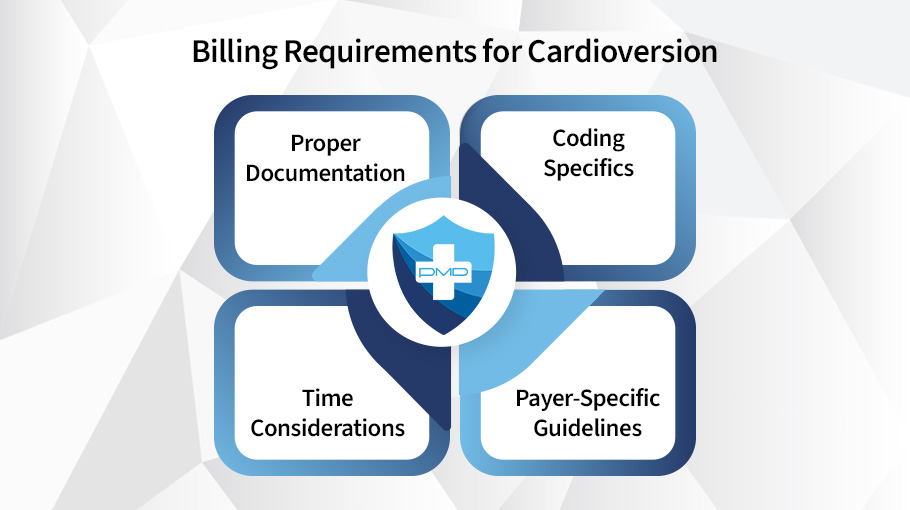
Proper Documentation
Ensure the following elements are included:
- Medical necessity for Medical billing for Cardioversion (e.g., persistent atrial fibrillation)
- Type of cardioversion (external, internal, or chemical)
- Pre- and post-procedure rhythm strips or ECG documentation
- Sedation and anesthesia details, if applicable
Coding Specifics
- Use 92960 for external electrical cardioversion without TEE or anesthesia
- Use 92961 for internal cardioversion
- Pair with appropriate codes for TEE, anesthesia, or pharmacologic agents as needed.
Time Considerations
CPT codes 92960 and 92961 are not time-based, but documentation should reflect the complexity and duration of the procedure, particularly if additional services are billed.
Payer-Specific Guidelines
Coverage may vary by payer, especially for repeat cardioversion, combined procedures (e.g., cardioversion with TEE), or sedation services. Always verify:
- Prior authorization requirements
- Modifier usage (e.g., -59, -25)
- Bundled service policies
Common cardioversion billing errors
- Misuse of 92960 for pharmacologic cardioversion – Use infusion or injection codes for adenosine or other antiarrhythmic drugs.
- Inadequate documentation – Missing ECG tracings, rhythm descriptions, or medication timing can result in denials.
- Bundling issues – Some payers may bundle TEE, anesthesia, or sedation services. Use modifiers correctly when unbundling is appropriate.
- Failure to distinguish internal vs. external cardioversion. This affects the choice between 92960 and 92961.
Compliance in Cardiology Billing
- Ensure your clinical and billing teams are up-to-date on the latest CPT updates and payer rules.
- Always specify whether the cardioversion was external, internal, or chemical, and whether it was elective or emergent.
- Templates and macros in EHRs can help standardize documentation and reduce omissions that lead to billing denials.
- Coordinate with anesthesia, cardiology, and billing departments to avoid duplicate or missed billing opportunities.
Conclusion
Cardioversion CPT codes, including 92960, 92961, are vital for accurate billing and reimbursement in cardiovascular care. Proper use of these codes supports compliance, fair compensation, and improved patient outcomes.
By understanding code nuances, maintaining detailed documentation, and aligning with payer-specific guidelines, healthcare providers can streamline medical billing for Cardioversion and reduce the risk of claim denials.
FAQs
1. Is Cardioversion a medical procedure?
Cardioversion is a medical procedure used to treat abnormal heart rhythm like atrial fibrillation or atrial flutter using electrical shock or anti-arrhythmic medications.
2. What to code for Defibrillation?
There is not a standalone CPT code for defibrillation, as it is generally the part of Cardiopulmonary Resuscitation (CPR) coded as the part of it. It is included under the umbrella of CPR services.
3. Which CPT code is used for electrical cardioversion?
The CPT code for electrical cardioversion is 92960, representing (non-emergency) external cardioversion procedure.
4. Does CPT code 92960 require a modifier?
As CPT code 92960 represents (non-emergency) external cardioversion procedure, may need certain modifiers based on the specific circumstance of the treatment.
5. Why Accurate medical billing is crucial?
Accurate medical billing is not essential for healthcare professionals but also important for patient experience. Even minor errors can create far reaching negative consequences for healthcare professionals, patients and insurers.
6. What is the difference between internal and external cardioversion?
Internal and external cardioversion are procedures that restore normal heart rhythm using electrical shocks. Internal cardioversion delivers shocks through a catheter placed inside the heart, while external cardioversion uses electrodes to apply shocks from outside the body.