
Understanding and correctly applying ICD-10 code Z98.890 is more than just a coding task; it’s a strategic move to improve billing accuracy and enhance collection outcomes, especially in the complex world of workers’ compensation claims and collections. If you’re navigating workers’ compensation California lien collections or running a healthcare practice looking for ways to boost Workers’ Compensation Collection Services, this article will walk you through how one seemingly small code can play a big role.
What Is ICD-10 Code Z98.890, Really?
Z98.890 stands for “Other specified postprocedural states.” Sounds vague, right? But it has a very specific function. This code is used when a patient has had a past surgery or procedure that is no longer active, meaning no ongoing treatment or complications exist, but that history is still relevant to the patient’s current care.
Let’s say a patient had a spinal fusion five years ago and now comes in for physical therapy due to limited mobility. That past procedure matters. While it may not be the root cause of the current condition, it informs treatment decisions, billing and insurance processing.
Why It Matters in Workers’ Compensation
There are a lot of stakes involved in workers’ compensation claims and collections. Payment delays or denials can result from even the tiniest paperwork error or faulty code. The situation in California is considerably more dire. Workers’ compensation California lien collections often hinge on demonstrating that care was necessary and related to the work injury, or connected in a meaningful way.
Z98.890 can be a powerful tool here. It provides context. It shows that the patient’s medical history—like a prior orthopedic surgery—might impact recovery, pain levels, or physical limitations. And when it’s properly documented and linked to a current service or complaint, it helps justify the necessity of the care provided.
Billing with Z98.890: Don’t Do It Alone
This isn’t a code you just slap on a claim to fill space. Using Z98.890 effectively requires solid documentation. Clinicians must clearly note that the patient is post-procedure, there are no complications, and the surgery still influences today’s visit.
Here’s how to make it work:
- Always pair it with a primary diagnosis—Z98.890 cannot stand alone.
- Ensure the note reflects no active complications.
- Document the type and date of the prior procedure.
The worst part is that, when applied properly, this code aids in proving medical necessity. In Workers’ Compensation Collection Services, where payers want all the boxes checked before they write a check, it is a big concern.
Real-Life Example: From Rejection to Collection
A physical therapy clinic in California was treating a patient who had back surgery three years ago after a workplace fall. The clinic coded the visit under generic back pain and submitted the claim, which got denied.
After an audit, they resubmitted with clearer documentation, included Z98.890 to indicate post-surgical status, and tied the treatment plan to the patient’s prior surgery. This time? Approved and paid.
That’s the power of strategic coding, especially in workers’ compensation California lien collections, where adjusters need context and clarity to approve claims.
Avoid These Common Mistakes
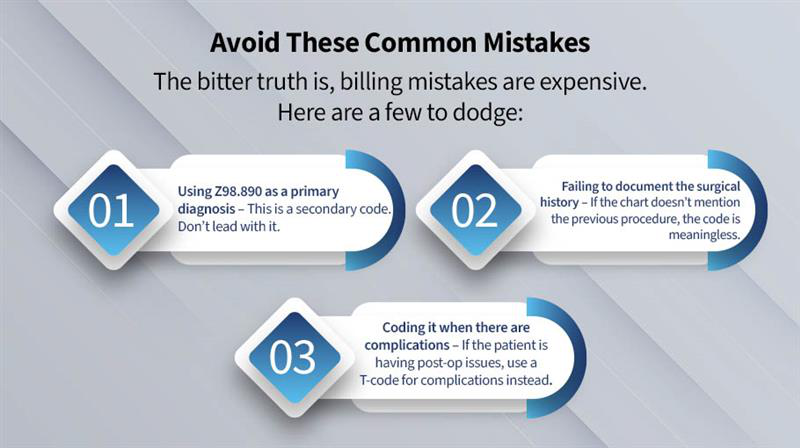
The bitter truth is, billing mistakes are expensive. Here are a few to dodge:
- Using Z98.890 as a primary diagnosis – This is a secondary code. Don’t lead with it.
- Failing to document the surgical history – If the chart doesn’t mention the previous procedure, the code is meaningless.
- Coding it when there are complications – If the patient is having post-op issues, use a T-code for complications instead.
Post-Procedure Doesn’t Mean Irrelevant
Healthcare providers sometimes think, “That surgery was years ago, why mention it now?” But in workers’ compensation claims and collections, every detail helps build the case.
Imagine you’re trying to collect for treatment on a patient with shoulder pain. The payer says the issue isn’t work-related. But the patient had a rotator cuff repair after a workplace accident. That prior surgery, captured with Z98.890, becomes evidence. It tells the story. It proves the ongoing need for care. And it supports the lien you’re trying to collect.
A Secret Weapon in Lien Collections
Here’s a pro tip: Proper use of codes like Z98.890 can make or break your lien. In the tangled web of workers’ compensation California lien collections, clear documentation of past procedures demonstrates a chain of care. And adjusters love a well-documented trail; it speeds up approvals and payments.
Even better, when paired with a partner who understands Workers’ Compensation Collection Services, you’re more likely to get your money and get it faster.
How PureMD Can Help
At PureMD, we don’t just handle medical billing; we specialize in workers’ compensation claims and collections. That includes managing liens, optimizing coding, and fighting for every dollar you deserve. We understand the small details that make a big difference, like Z98.890.
Our team helps:
- Ensure proper documentation
- Apply accurate ICD-10 codes.
- Submit clean claims
- Appeal against unjust denials
- Manage complex lien collections in California.
If you’re tired of chasing payments and fighting through red tape, let us help. We handle the paperwork, so you can focus on patient care.
FAQs
- Can Z98.890 ever be a primary diagnosis?
No. It’s always secondary and meant to support another condition or symptom
2. Do I need to specify the surgery date?
Yes, document the procedure date/type to avoid being flagged for incomplete documentation.
3. What if complications appear later?
Once complications (e.g., infection) arise, use the proper T- or complication code instead of Z98.890.
4. Is Z98.890 covered during inpatient admission?
Yes, it’s exempt from POA rules and acceptable for inpatient claims.
5. How to distinguish follow-up Z codes from postprocedural Z codes?
Use Z47 or Z51 for aftercare; Z98.890 is for status without active follow-up, complications, or ongoing care.
Final Thoughts
Code for ICD-10: It’s not only a “status” code, Z98.890. It serves as a calculated reminder to adjusters and payers that your patient’s medical history is important. When properly used, it serves as a link between previous practices and current treatment, which is essential for workers’ compensation claims and collections. Z98.890 helps your tale make sense and earn you money in a system where each code tells a story.