
The ICD-10-CM (International Classification of Diseases, 10th Revision, Clinical Modification) applies to workers’ compensation billing in the USA. It is the standardized system for disease diagnosis codes in U.S. healthcare. It replaced ICD-9 in 2015, expanding the number of codes from about 14,000 ICD-9 codes to over 70,000 in ICD-10.
These diagnosis codes used in workers’ compensation billing can be 3 to 7 characters long, where each extra character adds specificity about the injury’s type, location, severity, or encounter status.
Importantly, workers’ compensation claims have some special billing requirements beyond just the codes used. For example, a worker’s CMS-1500 compensation claim must include the date of initial injury (the date the case was opened with the carrier) and the insurer’s specific case number without the patient’s SSN on the form.
In this post, we’ll cover how diagnosis coding works in workers’ compensation claims across the USA, focusing on the shift from ICD-9 to the current system, how it’s implemented in workers’ comp billing, and best practices healthcare providers should follow to stay compliant and accurate.
The Shift From ICD-9 to ICD-10
Since the transition to the new coding system was a major shift, the U.S. healthcare industry set a firm implementation date. Effective October 1, 2015, all new claims (including workers’ compensation) were required to use ICD-10-CM codes.
Notably, workers’ compensation systems are not always subject to federal HIPAA mandates on claims. In many U.S states, In many cases, adoption was effectively voluntary or driven by carrier practices rather than by law. For instance, Wisconsin’s Worker’s Compensation Division explained that its statutes do not give it authority to require any particular coding system.
Even so, nearly all payers and healthcare providers across the country began using the updated codes between 2015 and 2016 to align with national standards and reduce confusion. Today, these codes are an essential part of workers’ compensation billing in the United States.
Implementing ICD-10 in Workers’ Compensation Billing in the USA
When billing workers’ compensation claims, providers must follow both standardized coding rules and payer-specific requirements. Unlike typical health insurance claims, many carriers and state funds have additional fields or documentation guidelines. Some even require secondary or tertiary diagnosis codes to explain exactly how the injury occurred at work.
For example, the ICD-9 code V62.1 (“Adverse effects of work environment”) was commonly used in the past. Its modern equivalents include more detailed occupational exposure codes such as V57.0–V57.9. Selecting the right secondary code is essential, as it confirms that the condition is work-related and eligible for coverage.
In most cases, workers’ compensation billing uses a mix of diagnostic and procedural codes—pairing ICD-10-CM for diagnoses with CPT/HCPCS for procedures. Outpatient and office visits typically use the same CPT codes as standard medical billing, while inpatient hospital cases may require ICD-10-PCS codes. However, the latter is rare outside of emergency or severe injury hospitalizations.
Keeping Codes Current and Accurate
The diagnostic code set is updated every year by CMS, which adds new entries, removes outdated ones, and revises descriptions based on medical advancements. These yearly updates make it vital for providers and coders to stay current with the latest guidelines.
If a workers’ compensation payer finds a code error, they’ll usually request a corrected claim—slowing down reimbursements. This is why precise documentation and expert coding practices are essential to maintaining compliance and avoiding payment delays.
Best Practices for ICD-10 Workers’ Compensation Coding
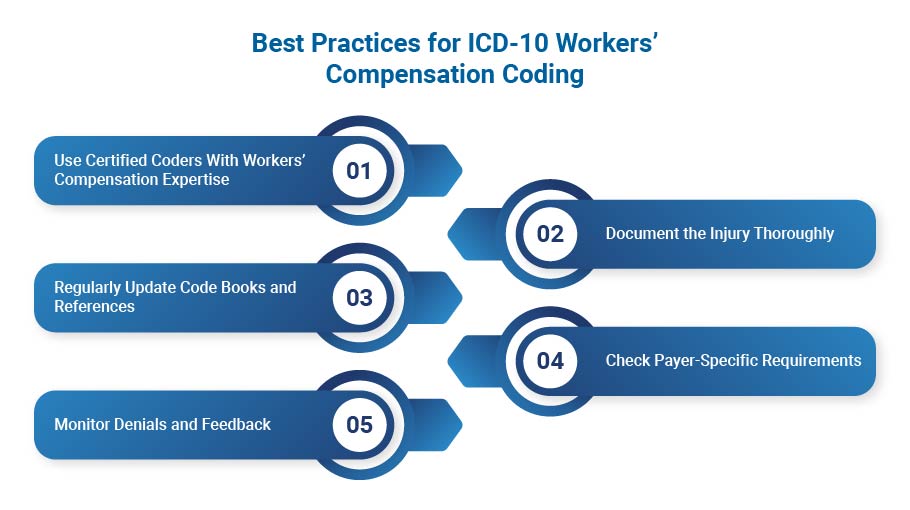
Given the complexity of ICD-10, healthcare providers should follow several best practices:
-
Use Certified Coders With Workers’ Compensation Expertise
The annual updates and underlying complications mean coding mistakes are easy to make. Specialists trained in workers’ compensation billing understand which codes to pick and which optional codes to include to satisfy each carrier’s rules.
For example, expert coders will maintain code specificity and follow all state fee schedules and regulatory requirements. They also verify that diagnoses and procedures are all work-related and properly documented.
-
Document the Injury Thoroughly
The medical record should spell out the mechanism of injury (e.g., fall, repetitive strain, equipment accident) and all injured body parts. This lets the coder select the most specific code. If there is any doubt, coders may query the provider for clarification. Omitting a needed detail can force the use of a more generic code, which may slow down claims.
-
Regularly Update Code Books and References
Whether using online code lookup tools or paper, ensure the code books and references reflect the current year’s ICD-10-CM edition. CMS and other coding organizations publish addenda and errata as the year progresses, so teams should note any mid-year changes.
-
Check Payer-Specific Requirements
Some payers have unique instructions for ICD-10 usage. For instance, they may want certain secondary codes, specific billing forms, or questions answered. It’s wise to communicate with payers or use a clearinghouse that applies payer rules.
-
Monitor Denials and Feedback
If claims are denied, review the EORs (Explanations of Review) closely. Common denial reasons include incorrect coding, coding a non-work-related condition, or missing a required modifier. Quickly correcting these issues and appealing when appropriate helps keep revenue flowing.
Value of Engaging With Expert Workers’ Compensation Billing Services
For many practices, staying on top of ICD-10 coding, CPT use, state regulations, and form requirements can be a hassle. This is why clinics often work with dedicated workers’ compensation claims experts. Experienced billing companies have teams of coders and billers who use specialized software and stay updated on the latest coding guidelines.
Regardless of whether billing is done in-house or by a partner, the key is precision and expertise. Accurate ICD-10 coding not only leads to effective workers’ compensation solutions but also better statistical tracking.
Moreover, workers’ comp stakeholders, such as insurers, safety programs, and occupational health researchers, rely on ICD-10 data to analyze injury trends. Well-coded claims help all parties by reducing disputes and clearly communicating the nature of work injuries.
Frequently Asked Questions (FAQs)
Do I need to use ICD-10-PCS procedure codes for workers’ comp claims?
Generally, no. ICD-10-PCS codes are used for inpatient hospital procedures, not for physician or outpatient services. Most workers’ comp providers (clinics, therapists, etc.) use CPT or HCPCS codes to bill their procedures.
Are external cause (W, X, Y) codes required on comp claims?
Not typically. External cause codes (W, X, Y, Z) describe how an injury occurred. Most workers’ comp claims don’t require them because the accident details are usually captured elsewhere.
How do I code follow-up visits for a work injury?
Use the 7th-character “subsequent encounter” codes in ICD-10. On follow-up visits for the same injury, you would use D (subsequent encounter) in that last position.
Is ICD-10 mandatory for all workers’ comp claims?
Interestingly, not by federal mandate. Workers’ compensation claims are generally exempt from HIPAA transaction rules, so many states did not force an ICD-10 deadline through their laws.
Can ICD-10 codes in workers’ compensation be used for injury trend analysis?
Yes, ICD-10 data helps insurers and regulators analyze workplace injury patterns, identify high-risk industries, and design safety programs.
Making a Difference to Your ICD-10 Coding Compliance
If your practice is struggling with denied bills or slow reimbursements, it can use the valuable help of workers’ compensation billing services experts to negotiate with carriers, review lien opportunities, and follow compliance standards. This is where PureMD can be a game-changer for your practice!
PureMD is a leading provider of effective workers’ compensation solutions in the U.S. We specialize in handling the full billing cycle for workers’ compensation and personal injury cases. Our team has deep expertise in ICD-10 and state billing rules, so you can trust that your claims are coded and submitted correctly from the start.
With PureMD on your side, you gain a partner committed to excellence in billing and collections. Reach out to PureMD now to get started and ensure your coding and billing comply with the highest standards.