
Nail disorders, including onychomycosis, are commonly encountered in clinical practices and can significantly affect patient comfort and recovery. Even mild infections may slow healing after an injury or make daily activities more difficult.
Managing these conditions requires clear documentation and accurate coding to support claims and maintain compliance. Personal injury billing services help practices capture these details, ensuring every diagnosis is recorded correctly and claims are submitted efficiently.
This blog will review the ICD-10 codes for onychomycosis and other nail disorders while providing guidance on documentation and billing strategies that improve both clinical and administrative outcomes.
Onychomycosis and Other Common Nail Disorders
Onychomycosis is a fungal infection of the fingernails or toenails. It can cause nails to thicken, discolor, become brittle, or separate from the nail bed. Dermatophyte fungi are the most common cause, though yeast and molds can also contribute to it. Even mild infections can cause discomfort or complications, especially after injuries.
Trauma-Related Nail Disorders
Not all nail problems are caused by fungi. Injuries from accidents, repetitive strain, or workplace incidents can trigger onycholysis, damage the nail bed, or cause nails to split. These trauma-related issues can affect one nail or several at the same time and can make everyday tasks uncomfortable if left untreated. Recognizing the cause early helps providers choose the right treatment and accurately document the condition.
Other Nail Disorders
- Ingrown nails: Nail grows into the surrounding skin, causing pain or infection.
- Nail dystrophy: Nails become irregular, thickened, or brittle.
- Beau’s lines: Horizontal depressions caused by illness or trauma.
- Leukonychia: White discoloration of the nails.
- Yellow nail syndrome: Thickened yellow nails linked to systemic issues.
Nail Disorders Linked to Systemic or Chronic Conditions
Nail abnormalities can also reflect underlying health conditions such as diabetes, circulatory problems, or autoimmune diseases. It’s important to identify whether a disorder is injury-related, disease-related, or a combination to assign the correct ICD-10 code.
ICD-10 Code for Onychomycosis (B35.1)
The designated ICD-10 code for onychomycosis is B35.1 – Tinea unguium.
This code applies when a fungal infection of the nail is diagnosed through clinical assessment or confirmed by laboratory testing. Documentation should specify which nails are affected, the severity of the infection, and any contributing factors such as previous injury or chronic illness.
Billing teams that manage personal injury billing services use this information to align diagnoses with procedure codes and claim requirements, reducing administrative corrections and improving payment consistency.
|
ICD-10 Code |
Condition |
Description / When to Use |
|
L60.0 |
Ingrown nail |
Nail margin penetrates the surrounding skin, causing inflammation or infection |
|
L60.1 |
Onycholysis |
The nail plate separates from the nail bed, often due to trauma or infection |
|
L60.2 |
Leukonychia |
White discoloration of the nail caused by trauma or systemic factors |
|
L60.3 |
Nail dystrophy |
Irregular, brittle, or thickened nails are often linked to chronic irritation or disease |
|
L60.4 |
Beau’s lines |
Horizontal depressions across nails resulting from illness or injury |
|
L60.5 |
Yellow nail syndrome |
Chronic yellow discoloration of nails associated with lymphedema or respiratory conditions |
|
L60.8 |
Other nail disorders |
For nail conditions not specified in other codes |
|
L60.9 |
Nail disorder, unspecified |
Used when the clinical picture is incomplete or unspecified |
|
L03.0 |
Cellulitis and abscess of the finger or toe |
Infection extends beyond the nail fold or soft tissues |
Top Coding Mistakes That Affect Nail Disorder Claims
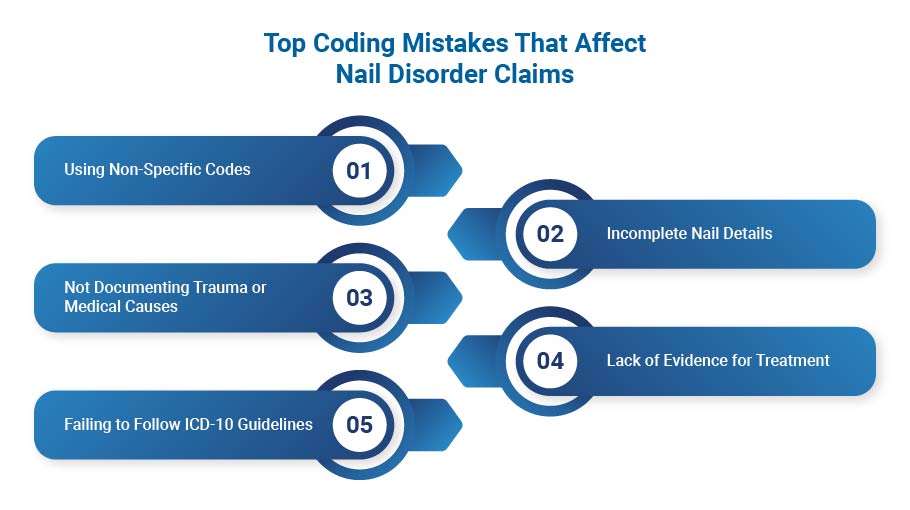
Accurate documentation is crucial in determining whether a claim is paid. Many nail disorder claims get denied because of avoidable mistakes. Knowing these mistakes helps practices follow the rules and get proper reimbursement.
-
Using Non-Specific Codes
Sometimes, billing staff use ICD-10 codes that do not describe the condition clearly. For example, coding a nail disorder as “unspecified” instead of onychomycosis, onycholysis, or nail dystrophy can cause the claim to be denied. Clear clinical notes and diagnostic details help coders select the correct code.
-
Incomplete Nail Details
Providers occasionally do not record which nails are affected or how many require care. Payers need this information to process claims accurately. Leaving out these details can slow payment or trigger requests for additional documentation.
-
Not Documenting Trauma or Medical Causes
Nail conditions may result from injuries, repetitive stress, or underlying health issues. If documentation does not describe the cause, payers may question the claim. Clearly stating whether a condition is injury-related, disease-related, or both strengthens coding and supports approval.
-
Lack of Evidence for Treatment
Insurers require supporting evidence to approve claims. Lab results, culture reports, and clinical notes provide proof of diagnosis and treatment. Without this information, claims are often denied.
-
Failing to Follow ICD-10 Guidelines
Each ICD-10 code has specific criteria. If documentation does not meet these standards, payers may delay or reject the claim.
Best Practices for Billing Nail Disorders with ICD-10 Codes
Clear and detailed documentation is essential for proper billing and claim approval. Accurate records not only support medical necessity but also help prevent claim denials and streamline the coding process.
Key documentation practices include:
- Include lab or culture results whenever available
- Specify which nails are affected and the severity of the condition
- Record trauma or systemic causes clearly
- Use compatible CPT codes for procedures such as nail debridement or biopsy
- Outsource personal injury billing services to manage complex claims efficiently
How Modern Billing Systems Handle Nail Disorder Claims
Managing nail disorder claims can be challenging when coding and documentation need to be accurate. Modern billing systems help practices organize patient information, track clinical notes, and connect diagnoses to the correct ICD-10 codes. This makes handling trauma-related, infection-related, or systemic nail disorders easier.
Electronic Health Record (EHR) software is a key part of these systems. It stores patient details, tracks treatments, and links clinical notes directly to billing codes. When paired with specialized billing software and personal injury billing services in California, practices can process claims efficiently by checking codes, matching procedures to diagnoses, and identifying missing information before submission.
Some systems also integrate lab results, procedure codes, and imaging reports, so all clinical evidence is included in each claim. This improves accuracy and lowers the risk of denials.
Digital dashboards and reporting tools give staff a clear view of claim status. They can quickly identify missing details, follow up on pending claims, and manage claims effectively. With modern billing systems, practices can handle nail disorder claims reliably while maintaining compliance and timely reimbursement.
FAQs
What is the ICD-10 code for onychomycosis?
The ICD-10 code for onychomycosis is B35.1 Tinea unguium. It is used for confirmed fungal nail infections.
How are trauma-related nail disorders coded?
Codes like L60.1 for onycholysis are used. Record the cause and affected nails for accuracy.
Why do nail disorder claims get denied?
Claims are denied when details about nails, cause, or lab results are missing. Clear documentation is the key to achieving clean claims.
Can billing services help with nail disorder claims?
Yes, personal injury billing services review documentation, verify codes, and handle complex nail disorder claims.
What improves billing accuracy for nail disorders?
Including lab results, specifying affected nails, noting trauma or medical causes, and using the right CPT codes can all improve billing accuracy for nail disorders.
Final Thoughts
Accurate ICD-10 coding and thorough documentation help healthcare providers manage nail disorder claims effectively. Maintaining detailed records allows practices to submit claims correctly and supports timely care for patients.
In personal injury billing, teams assist practices by reviewing claims, verifying codes, and handling complex documentation. When combined with modern EHR and billing software, these services make it easier to record and bill trauma-related, infection-related, or systemic nail disorders accurately.
Following best practices for coding and documentation helps healthcare providers handle claims with confidence and reduce administrative issues. Practices that use these methods stay on top of nail disorder billing while delivering high-quality patient care.