
Forswearing the board could seem like a dry, regulatory term. In any case, in medical services, a vital component guarantees the smooth activity of clinical practices and the monetary strength of medical services suppliers. At any point, ask why some protection claims are dismissed or deferred. This is where refusal the executives step in to make all the difference. We should jump into the repudiation of the board and how it attempts to keep the medical care framework ticking.
Understanding Denials
In medical care, a disavowal is the point at which an insurance agency will not pay for a clinical benefit or therapy given to a patient. Multiple factors can cause this, upsetting medical care suppliers’ income cycles.
Common Types of Denials
-
Clinical Denials
Clinical refusals happen when the insurance agency establishes that help or therapy isn’t restoratively essential or doesn’t meet the clinical measures set by the guarantor.
-
Administrative Denials
Authoritative disavowals, then again, are because of non-clinical issues like charging mistakes, inaccurate patient data, or missing documentation.
Reasons for Denials
Denials can happen for numerous reasons, but some of the most common include:
-
Coding Errors
Clinical coding is perplexing; surprisingly, minor mix-ups can prompt a case to be denied. Erroneous or jumbled codes can set off a refusal.
-
Lack of Documentation
Insurance agencies require definite documentation to endorse claims. Insufficient or missing documentation is a continuous reason for dissents.
-
Policy Issues
Sometimes, the administrations given are not covered under the patient’s insurance contract, prompting a refusal.
The Denial Management Process
-
Initial Assessment
The forswearing board interaction begins with an underlying appraisal of the denied guarantee to comprehend why it was excused. This includes assessing the subtleties of the case and the explanation given by the safety net provider.
-
Categorization of Denials
Then, refusals are sorted into clinical or managerial classifications. This aids in applying suitable goal procedures.
-
Root Cause Analysis
Recognizing the main driver of the forswearing is basic. This step includes digging further to determine the basic issues that prompted the forswearing, like procedural blunders or strategy misconceptions.
-
Resolution Strategies
When the underlying driver is recognized, systems are created to address and determine the refusal. This might incorporate adjusting coding blunders, providing extra documentation, or engaging the choice with the backup plan.
Tools and Technologies for Denial Management
-
Denial Management Software
Specific programming can assist with smoothing out the forswearing the board cycle via mechanizing assignments, following refusals, and giving investigation to distinguish examples and patterns.
-
Electronic Health Records (EHR)
EHR frameworks guarantee that precise and complete patient data is accessible, which is fundamental for forestalling disavowals.
-
Data Analytics
Utilizing information investigation, healthcare suppliers can gain insight into the normal explanations behind dissents and foster methodologies to decrease their events.
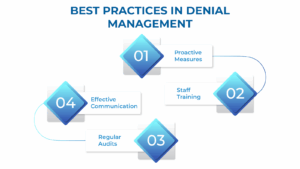
Best Practices in Denial Management
-
Proactive Measures
Making proactive strides, such as checking patient protection data before administrations are delivered, can diminish the risk of disavowals.
-
Staff Training
Normal staff preparing the most recent coding rehearsals, documentation necessities, and insurance contracts can help limit blunders that lead to dissents.
-
Regular Audits
Normal case reviews can help recognize and amend issues before they bring about refusals.
-
Effective Communication
Keeping up with open and compelling correspondence between medical services suppliers, charging divisions, and guarantors is fundamental for settling disavowals rapidly.
Role of Healthcare Professionals in Denial Management
-
Responsibilities of Billing Specialists
Charging experts are key in submitting exact cases and returning to refusals to guarantee they are settled speedily.
-
Role of Medical Coders
Clinical coders guarantee that the right codes are utilized for charging, which forestalls dissents because of coding blunders.
-
Importance of Compliance Officers
Consistency officials guarantee that the medical services supplier complies with every pertinent guideline and approach, which can help diminish the risk of refusals.
Impact of Denial Management on Revenue Cycle
-
Financial Implications
Viable refusal of the executives has huge monetary ramifications, as it gets the income medical care suppliers qualified for their administrations.
-
Enhancing Cash Flow
By diminishing the quantity of denied claims, medical care suppliers can upgrade their income, guaranteeing they have the assets expected to proceed with activities.
-
Reducing Accounts Receivable Days
Productive disavowal of the executives diminishes the time it takes to get installment for administrations delivered, consequently decreasing records receivable days.
Challenges in Denial Management
-
Complexities of Insurance Policies
Exploring the intricacies of different insurance contracts can be testing and frequently prompts refusals.
-
Evolving Healthcare Regulations
Medical care guidelines continually develop, and staying aware of these progressions is fundamental for forestalling dissents.
-
Resource Limitations
Restricted assets, such as staffing and innovation, can ruin the compelling disavowal of the board.
Future Trends in Denial Management

-
Artificial Intelligence and Machine Learning
Artificial intelligence and AI are set to change the forswearing of the board by giving prescient examinations and mechanizing routine errands, diminishing staff weight, and further developing exactness.
-
Predictive Analytics
A prescient examination can assist medical care suppliers with expecting likely dissents and making remedial moves before they happen.
-
Integration of Blockchain Technology
Blockchain innovation vows to improve the straightforwardness and security of clinical records, which can help lessen refusals due to documentation issues.
Bottom Line
In summary, denying claims is crucial in the healthcare revenue cycle. It involves identifying, analyzing, and resolving rejected claims to ensure that healthcare providers receive the payments they deserve. With the proper tools, strategies, and practices in place, healthcare providers can significantly reduce the occurrence of denials, thereby improving their financial stability and ensuring the delivery of quality care.